Resources

How Much Do You Really Need to Retire?

Resources

How Much Do You Really Need to Retire?

Why “rules of thumb” may fall short — and how DLAK’s approach helps bring clarity through simple math and personalization. 

It’s one of the most common questions we hear: “How much do I actually need to retire?” 
A quick search online gives you a dozen different answers — most of them framed as neat, round rules of thumb. Fidelity says you should aim for ten times your annual income by age 67. Others tell you to withdraw 4% per year and call it a day. These ideas make for good headlines, but they rarely hold up once real lives and real markets get involved. 

Take Fidelity’s “10x rule” as an example. If you have a pension and two Social Security incomes, that target becomes meaningless — your guaranteed income sources already change the math entirely. 

At DLAK, we’re not saying our approach is better; we’re saying it’s different. We believe financial planning shouldn’t be about chasing formulas created in a vacuum. It should be about applying logic, structure, and math to your actual circumstances — not someone else’s averages. 


Why “Monte Carlo” and Rules of Thumb may Miss the Mark 

Most big financial firms rely on a process called Monte Carlo simulation. It sounds impressive, and in theory, it’s useful: the model runs thousands of potential market paths to estimate your “probability of success” in retirement. But the problem is that these models are only as good as their assumptions — and those assumptions are usually based on long-term averages that don’t reflect individual needs. 

A Monte Carlo analysis might tell you there’s a 90% chance your plan “succeeds.” But what does that actually mean? It doesn’t tell you when your money might run low, or how your personal spending patterns, risk comfort, or market valuations affect that probability. It also assumes retirement starts at a single point in time — yet for many people, the definition is blurry. Is “retirement” the day you stop working, or the day all your guaranteed income sources begin? The 4% rule and other “success rate” models often miss that distinction. 

Financial planning doesn’t need to be abstract. It just needs to be clear. 


The DLAK Framework: Real Math, Real Personalization 

Instead of relying on generic assumptions, DLAK’s approach focuses on something much more tangible: how long your money will last under different distribution rates. 

To illustrate, let’s assume: 

  • 5% annual growth on investments – a deliberately conservative rate of return, designed to reflect long-term, risk-adjusted expectations rather than optimistic projections 
  • 2.5% inflation, meaning withdrawals rise each year to keep up with cost of living 
  • Withdrawals beginning at the point an individual starts taking income, rather than a fixed retirement age 

Then, we model how long that money lasts under different initial distribution rates: 

Initial Distribution Rate 

Years Until Money Runs Out

7.0% 

18 years 

5.75% 

23 years 

4.8% 

29 years 

4.0% 

38 years 

3.5% 

48 years 

3.0% 

66 years 

2.7% 

89 years 

2.35% 

Never 

This simple progression makes the tradeoffs clear. A higher distribution rate shortens your runway — dramatically. A lower one gives your portfolio endurance, sometimes indefinitely. 

But we don’t stop there — we also stress test each scenario. Roughly 80% of outcomes may turn out better than projected, but 20% could be worse. We model those less likely situations — prolonged market downturns, higher inflation, or delayed recoveries — so clients can see what happens if the unexpected occurs. 

For example, at a 3% initial distribution rate, the baseline projection lasts about 66 years. But if five years into retirement the portfolio experiences two consecutive years of –5% returns instead of the assumed +5%, the money would last 47 years instead. Or, if inflation averages 3% instead of 2.5%, that same portfolio would last about 53 years. 

These are not predictions — they’re illustrations of how resilient (or vulnerable) a plan may be when reality strays from the averages. 

Rather than hiding behind opaque simulations, we show clients the math directly: what each withdrawal rate means in practical terms, how long the money is likely to last, and what level of risk aligns with their comfort and timeline. 


Four Factors That Define Your Risk 

Our Risk Analyzer helps personalize this further by combining four key inputs: 

  1. Retirement year: How soon you plan to retire sets your baseline allocation — the closer you are, the more conservative your starting point. 
  1. Personal comfort with risk: Rated 1–10. A “10” tilts your portfolio toward more opportunity (e.g., 100/0 allocation), while a “1” emphasizes preservation (around 0/100). 
  1. Time until portfolio drawdown: This determines how much flexibility your plan truly has. Someone who will use most of their money within 10 years needs stability; someone who won’t touch most of it for 20+ years can afford to take more risk. 
  1. Market valuations: When markets are expensive, we pull back risk; when they’re undervalued, we lean in. 

Together, these inputs replace guesswork with logic. They make risk a reflection of your plan — not just your age. 


The 7-Year Rule: Protect What You’ll Need Soon 

A cornerstone of DLAK’s retirement philosophy is what we call the 7-Year Rule: 
Any money you expect to withdraw in the next seven years should not be in the stock market. 

If you plan to draw $50,000 a year, typically that means at absolute minimum $350,000 should be allocated to bonds or other fixed investments. This protects the portion of your assets that funds near-term spending, while allowing the rest the opportunity to participate in long-term growth. 

It’s a simple principle — but it’s often overlooked by models that treat every dollar the same. 


The Bottom Line: Simplicity Over Sophistication 

Fancy models and buzzwords make for great marketing, but they often obscure what really matters: time, math, and discipline. 

At DLAK, we don’t claim our process is superior — just that it’s more transparent. Retirement planning shouldn’t depend on generalized “success probabilities” or arbitrary savings multiples. It should be grounded in personalized math — understanding how long your money truly needs to last, how much risk that timeline can support, and how to structure withdrawals accordingly. 

Technology can be useful, but it can also create a false sense of certainty or insecurity. Real clarity comes not from algorithms, but from aligning your plan with the simple math of your life — and that’s exactly what we do every day. 

Disclosure:  
This material contains the current opinions of Robert Koscik and his team but not necessarily those of Guardian or its subsidiaries and such opinions are subject to change without notice. Any chart and graph  are for illustrative purposes and are not intended to suggest a particular course of action or represent the performance of any particular financial product or security. Past performance is not a guarantee of future results. This material is intended for general public use. By providing this content, Park Avenue Securities LLC and your financial representative are not undertaking to provide investment advice or make a recommendation for a specific individual or situation, or to otherwise act in a fiduciary capacity. 
Data and rates used were indicative of market conditions as of the date shown. Opinions, estimates, forecasts, and statements of financial market trends are based on current market conditions are subject to change without notice. References to specific securities, asset classes and financial markets are for illustrative purposes only and do not constitute a solicitation, offer, or recommendation to purchase or sell a security.  Guardian, its subsidiaries, agents, and employees do not provide tax, legal, or accounting advice. Consult your tax, legal, or accounting professional regarding your individual situation. Tax laws are always subject to change. 
 Securities products and advisory services offered through Park Avenue Securities LLC (PAS), member FINRA, SIPC. OSJ: 419 Plum Street; Cincinnati, OH 45202. Phone: (513) 579-1114. PAS is a wholly owned subsidiary of The Guardian Life Insurance Company of America (Guardian), New York, NY. DLAK Wealth Advisors LLC is not an affiliate or subsidiary of PAS or Guardian and is not registered in any state or with the U.S. Securities and Exchange Commission as a Registered Investment Advisor. 8600066.1 Exp 11/27 


Continue reading

  • Created on .

2025 Q4

Resources

Market Outlook

When the Market Gets This Expensive

Read more


Financial Planning

Is Working with Your Advisor Worth It?

Read more

How Much Do You Really Need to Retire?

Read more


Health

Live Longer, Move Smarter: The Five Pillars of Exercise for Longevity

Read more


Travel

Ready to Explore a Different Part of the World?

Read more


Consumer Reports

Shopping for a TV: What to Know About OLED vs. LED, Features, and Prices

Read more


Employee Spotlight

Staff Spotlight

Read more


Did you know?

Q4 2025 DYK

Read more

Continue reading

  • Created on .

Shopping for a TV: What to Know About OLED vs. LED, Features, and Prices

Resources

Shopping for a TV: What to Know About OLED vs. LED, Features, and Prices

Shopping for a new TV might not be something you do every year—and if you haven’t been in the market for a while, you’re in for a surprise. TVs have changed a lot. It’s not just about screen size anymore. Today’s sets offer sharper pictures, better contrast, smarter features, and designs that blend right into your living room. But with all the options—OLED, LED, HDR, refresh rates, and smart platforms—the big question is: how much should you spend? And what do you actually get for the money? Let’s break it down…

Start by Knowing Your Budget

If you’re shopping on the high end, a 55-inch TV can easily run between $1,500 and $2,500. At this level, you’re looking at OLED models. OLED (Organic Light Emitting Diode) panels are known for their deep blacks, vibrant colors, and incredible contrast. They’re the top pick for movie buffs, sports fans, and gamers who want the very best. Many of these TVs support advanced HDR formats, deliver high pixel density for ultra-clear images, and include the latest HDMI ports for smooth gaming performance. Other perks? Ultra-slim designs, superior motion handling, and smart features like voice control and personalized recommendations.

If You’re Aiming for the Middle

Mid-range TVs, in the $700 to $1,200 range, are where most buyers land. These are usually LED or QLED models. While they don’t hit OLED-level contrast, they still deliver excellent picture quality with bright displays that perform well in well-lit rooms. Mid-range sets typically offer 4K resolution, solid HDR support, and refresh rates that are more than good enough for most viewers. You’ll often find extras like local dimming (to improve black levels), decent upscaling for older content, and smart platforms with all the major streaming apps. These TVs strike a nice balance between performance and price, making them a solid choice for families or casual viewers.

Sticking to a Budget

On the low end, expect to pay $300 to $500 for a 55-inch set. These are entry-level LED TVs. You’ll still get 4K resolution, but the difference comes down to details: fewer dimming zones, lower peak brightness, and more limited HDR. That means blacks won’t look quite as deep, and fast-moving content might not be as smooth. However, budget models often come with easy-to-use smart platforms built in, making streaming simple and straightforward. If you just want a big screen for sports, movies, or casual gaming without breaking the bank, this category will work just fine.

Timing Matters

When’s the best time to buy? TV prices drop most significantly around Black Friday (late November), the Super Bowl lead-up (January/February), and spring sales (April/May) when new models launch. If you can hold out for these windows, you’ll often save hundreds.

Choose What Works for You

At the end of the day, it comes down to what matters most in your viewing experience. Do you want the absolute best picture quality for movie nights? Go OLED. Do you need something bright and versatile without overspending? A mid-range LED or QLED will fit the bill. Or, if budget is the top priority, you can still get a solid big-screen TV at an affordable price. Whatever you choose, today’s TVs are smarter, sharper, and more feature-packed than ever.

Disclosure:  
This material contains the current opinions of Robert Koscik and his team but not necessarily those of Guardian or its subsidiaries and such opinions are subject to change without notice. Any chart and graph  are for illustrative purposes and are not intended to suggest a particular course of action or represent the performance of any particular financial product or security. Past performance is not a guarantee of future results. This material is intended for general public use. By providing this content, Park Avenue Securities LLC and your financial representative are not undertaking to provide investment advice or make a recommendation for a specific individual or situation, or to otherwise act in a fiduciary capacity. 
Data and rates used were indicative of market conditions as of the date shown. Opinions, estimates, forecasts, and statements of financial market trends are based on current market conditions are subject to change without notice. References to specific securities, asset classes and financial markets are for illustrative purposes only and do not constitute a solicitation, offer, or recommendation to purchase or sell a security.  Guardian, its subsidiaries, agents, and employees do not provide tax, legal, or accounting advice. Consult your tax, legal, or accounting professional regarding your individual situation. Tax laws are always subject to change. 
 Securities products and advisory services offered through Park Avenue Securities LLC (PAS), member FINRA, SIPC. OSJ: 419 Plum Street; Cincinnati, OH 45202. Phone: (513) 579-1114. PAS is a wholly owned subsidiary of The Guardian Life Insurance Company of America (Guardian), New York, NY. DLAK Wealth Advisors LLC is not an affiliate or subsidiary of PAS or Guardian and is not registered in any state or with the U.S. Securities and Exchange Commission as a Registered Investment Advisor. 8600066.1 Exp 11/27 

Continue reading

  • Created on .

Is Working with Your Advisor Worth It?

Resources

Is Working with Your Advisor Worth It? 


There has always been a collective of individuals out there who feel managing their wealth independently is the best way to go. These individuals’ main argument is they don’t want to pay an advisor because they don’t see the “real value.” Unfortunately, here at DLAK, we have been preaching a similar idea. Not because there’s no value in working with an advisor, but because most advisors DON’T provide the value they should.   

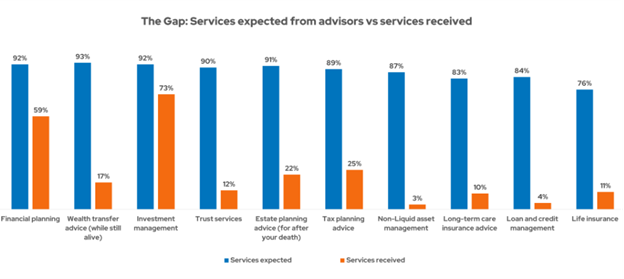
Since founding the firm 20 years ago, Rob has made it his mission to deliver the highest level of service to every client. In 2022, while attending a conference in Phoenix, he came across a powerful graphic that reinforced this troubling truth: despite investors expecting more holistic guidance, a 2021 Spectrum Group study revealed most advisors still fall short of providing it. 


Source: Spectrem August 2021 Defining Wealth Management 
Neither Envestnet, Envestnet | PMC nor its representatives render tax, accounting or legal advice. 


Advisors today are doing too little and getting paid too much!  

At DLAK, we are changing the script. We ensure every aspect of your financial life is covered, including all areas noted in the Spectrum study. For more than two decades, our mission has been to provide a comprehensive suite of services, including investment management, protection planning, financial planning, gifting and philanthropy, and wealth transfer strategies. 

So now, let’s take a look at four simple, straightforward examples that highlight the real value you receive by working with a DLAK Advisor, compared to the industry standard. 


Example #1: Trading Frequency  

Though there is wide variation, the average actively managed portfolio has a turnover rate of roughly 80% per year—a clear sign of how frequently many investors trade. To illustrate the impact of this, let’s consider a hypothetical investor with the following baseline assumptions: (source:icfs.com)

  • Taxable account value: $500,000 
  • Annual turnover: 80% 
  • Annual capital gains: $20,000 
  • All short-term gains taxed at a 22% marginal rate 

This hypothetical investor would pay roughly $88,000 in taxes over a 20-year period just because they frequently traded their brokerage account. 

Had this investor worked with DLAK, they would have learned that frequent trading doesn’t belong in a taxable account. Instead, they’d keep higher-turnover strategies in an IRA or Roth IRA and manage the brokerage account more efficiently. By reducing turnover to 10% and realizing only $2,500 in long-term capital gains per year, taxes over 20 years could drop to around $7,500. 

Over 20 years, a smart, tax-efficient advisor could have potentially saved this client $80,500 in taxes. 


Example #2: Retirement Asset Location 

Understanding the difference between certain types of tax registrations (Traditional IRA, Roth IRA, Taxable Brokerage Account, etc.) could save clients hundreds of thousands of dollars over their lifetime. A traditional IRA uses pre-tax money, grows tax-deferred, and is taxed on withdrawal, while a Roth IRA uses after-tax money and grows and qualified withdraws are income tax-free. 

Consider a 40-year-old client with $500,000 in a Traditional IRA and a Roth IRA. Both accounts are allocated 50% stocks and 50% bonds. The individual pays a total effective tax rate of 28% tax, earning 6% annually (assuming stocks return 9%/year & bonds yield 3%/year). Without tax-aware planning, they’d end up with ~3.7 million in after tax, spendable dollars. 

With DLAK’s guidance, allocations are adjusted: typically the Roth is 100% stocks, the traditional IRA 0% stocks (keeping the overall risk level the same – 50/50). Assuming the same market returns as above, the individual would end up with roughly $4.05 million over that same 25-year period. 

A potential savings of over $310,000! 


Example #3: Social Security Maximization 

Many people view their Social Security benefit as an individual benefit taken independently of the other spouse. In some cases that may be true (if you are single, spouse passes away, etc.), but for most MFJ (married filing jointly) couples the benefit needs to be looked at differently.  


Given the example below, let’s look at how maximizing Social Security could help make you hundreds of thousands of dollars better off over your lifetime. 

  • Spouse 1 is 62 years old and has a full retirement age (FRA) benefit of $45,000 per year. 
  • Spouse 2 is 60 years old with an FRA benefit of $25,000 per year. 

In this example, we will compare three scenarios:  

  • Both take at 62 – as soon as possible 
  • Both take at FRA (67) – when you get full benefit 
  • Maximization - The younger spouse takes their smaller benefit at 62 and the other spouse delays the higher benefit till 70 


Scenario 1: If the couple ignores a joint benefit strategy and both spouses claim their Social Security benefits as soon as they are eligible, the results can be costly. Assuming one spouse passes away at the normal individual life expectancy of 80, while the surviving spouse lives until the joint life expectancy of 90, the couple would receive a total of $1.588 million in benefits from the government. 


Scenario 2: If both spouses wait to claim their full Social Security benefits at their full retirement age of 67, and assuming the same life expectancy assumptions as in Scenario 1, the couple would receive a total of $1.834 million in benefits from the government. 


Scenario 3: By maximizing their benefits—having the younger spouse claim their smaller benefit at 62 while delaying the higher benefit until age 70, which increases it by 8% for each year delayed between 67 and 70—the couple, assuming the same life expectancy assumptions as in Scenarios 1 and 2, would receive a total of $1.88 million in benefits from the government. 


By thinking about Social Security as a joint benefit and using the maximization strategy, this client ended up $300,000 better off than if they had claimed benefits immediately and $50,000 better off than if they had waited until full retirement age.  


Example #4: Charitable Gifting Strategies 

Gift Bundling – At our firm, we have access to several options one being a Donor-Advised Funds (DAFs) to help clients manage taxes during high-income years. By contributing a portion of a bonus, business sale, or investment gain to a DAF, clients receive an immediate tax deduction, lowering their taxable income. The funds can then be donated to charities over time, allowing clients to smooth income spikes, stay in lower tax brackets, and preserve more after-tax wealth while supporting the causes they care about.   

Consider a couple in the 24% tax bracket that typically takes the $31,500 standard deduction each year. They normally have $10,000 in SALT taxes, $10,000 in mortgage interest, and give $10,000 to charity ($30k total of itemized deductions - still below the standard deduction threshold). This person gets ZERO benefit for the $10,000 they gave, because they end up taking the standard deduction and not getting to write off the gift as they would had they itemized.  

If this person instead bundles their giving using a donor-advised fund (DAF), they could give 3 years' worth of charitable contribution ($30,000) and take the tax deduction all in one year. With a charitable deduction of $30,000, SALT of $10,000, and mortgage interest of $10,000, the total itemization would now be $50,000 — more than the standard deduction. Now, the individual gets to write off $18,500 ($50,000 itemizations - $31,500 standard deduction) of their charitable gift. That is roughly $6,167 of extra tax deferment each year.  


At a tax rate of 24%, this individual would get an extra tax break of $4,440 every 3 years. Over a 20-year period, this strategy could result in savings of approximately $30,000. 


Conclusion  

Financial outcomes depend on coordinating taxes, account allocation, spending, and charitable planning — not just picking investments. While individuals may be able to attend to one or two of these areas while balancing a full-time job, by working with the RIGHT ADVISOR, you could have the ability to take advantage of all of these strategies and more.    


When you combine all the savings outlined above, an individual could pocket a staggering $600k roughly over 20 years — an extra $30,000 per year in your hands! Imagine a $2 million investment portfolio paying a 1.00% advisory fee — $20,000 per year. By simply implementing these four strategies, not only could you cover your advisory fee, but you’d still walk away with over $10,000 extra in your pocket every year.  


Paying an advisor to do nothing doesn’t make sense, but paying the RIGHT advisor could save you millions over your lifetime.  

Disclosure 

All scenarios and names mentioned herein are purely fictional and have been created solely for training purposes. Any resemblance to existing situations, persons or fictional characters is coincidental. The information presented should not be used as the basis for any specific investment advice. 
This material contains the current opinions of Robert Koscik and his team but not necessarily those of Guardian or its subsidiaries and such opinions are subject to change without notice. Any chart and graph  are for illustrative purposes and are not intended to suggest a particular course of action or represent the performance of any particular financial product or security. Past performance is not a guarantee of future results. This material is intended for general public use. By providing this content, Park Avenue Securities LLC and your financial representative are not undertaking to provide investment advice or make a recommendation for a specific individual or situation, or to otherwise act in a fiduciary capacity. 
Data and rates used were indicative of market conditions as of the date shown. Opinions, estimates, forecasts, and statements of financial market trends are based on current market conditions are subject to change without notice. References to specific securities, asset classes and financial markets are for illustrative purposes only and do not constitute a solicitation, offer, or recommendation to purchase or sell a security.  Guardian, its subsidiaries, agents, and employees do not provide tax, legal, or accounting advice. Consult your tax, legal, or accounting professional regarding your individual situation. Tax laws are always subject to change. 
 Securities products and advisory services offered through Park Avenue Securities LLC (PAS), member FINRA, SIPC. OSJ: 419 Plum Street; Cincinnati, OH 45202. Phone: (513) 579-1114. PAS is a wholly owned subsidiary of The Guardian Life Insurance Company of America (Guardian), New York, NY. DLAK Wealth Advisors LLC is not an affiliate or subsidiary of PAS or Guardian and is not registered in any state or with the U.S. Securities and Exchange Commission as a Registered Investment Advisor. 8600066.1 Exp 11/27 
 

Continue reading

  • Created on .

Q4 2025 DYK

Resources

Q4 2025 DYK

BUYERS’ MARKET. The typical home sold in July spent a median 43 days on the market — 8 days longer than a year earlier. That’s the longest time on the market for houses sold in July since 2015. All four regions in which homes sold in July were on the market the longest were in Florida.- Redfin

COLLEGE EDUCATED JOB STRUGGLES. In the NY Fed’s tri-annual Labor Market Survey, the percentage of college-educated workers that received a job offer in the last four months fell from 21.4% two years ago to just 13.9% in July. Over the same period, the percentage of non-college educated workers that received an offer rose from 18.4% to 20.1%- NY Fed

TIP ANXIETY. 54% of diners now feel pressured by preset tipping screens, up 7 percentage points from a year ago. 44% of consumers say they have cut back on tipping at restaurants, and 29% would prefer to completely eliminate tipping screens.

BIG BREADTH FOR SMALL STOCKS.On Friday, 8/22, 96% of the stocks in the small-cap Russell 2000® finished higher on the day — a 99th percentile daily breadth reading for the index dating back to 2010. Six months after similar 99th percentile breadth readings, the index averaged a gain of 13.1% with gains 100% of the time. (Source: Bespoke)

IT’S ALL TECH. Of the 11 sectors in the S&P 500, technology is the only one that outperformed the index’s 36% gain in the six months following the 4/8 low. While technology gained 62.2%, four sectors gained less than 20%: energy (+18.4%), real estate (+13.3%), health care (+9.7%), and consumer staples (+3.3%). (Source: Bespoke)

EGG PRICES DOWN 80%+.After topping $8/dozen in February following bird flu outbreaks, wholesale large USDA egg prices have fallen 82% to just over $1.50/dozen. The US currently has about 290 million table-laying hens, compared to 340 million in January 2020. US consumers purchase nearly 100 billion eggs annually. (Source: USDA)

ON THE BRINK OF RECESSION. Moody’s Analytics estimates that 22 states are currently experiencing recessionary conditions, and another 13 are “treading water.” California and New York are two states teetering on the edge, and if either falls into a recession, Moody’s estimates that the US economy will, too.(Source: MarketWatch)

NOT BOTHERED BY THE SHUTDOWN. 65% of Americans say that the government shutdown has had no impact on their timelines to make a major purchase, such as a home or car. Of those impacted, 17% have delayed major purchase plans and another 7% have canceled plans altogether. (Source; Redfin)

DId You know...1 in 7 people age 35–65 will be disabled for 5+ years.

DId You know...48% of all home foreclosures are the result of disability, while only 3% result from death.

All the world’s bacteria stacked on top of each other would stretch for 10 billion light-years. Together, Earth's 0.001mm-long microbes could wrap around the Milky Way over 20,000 times.

Wearing a tie can reduce blood flow to the brain by 7.5 per cent. A study in 2018 found that wearing a necktie can reduce the blood flow to your brain by up to 7.5 per cent, which can make you feel dizzy, nauseous and cause headaches. They can also increase the pressure in your eyes if on too tight and are great at carrying germs.

Scotland has an extensive vocabulary for snow, with the Historical Thesaurus of Scots documenting over 400 words for it.

Abraham Lincoln was a licensed bartender before he became President. Abraham Lincoln was the only President who was a licensed bartender. Lincoln’s liquor license was discovered in 1930 and displayed in a Springfield liquor store.

Deepest part of the ocean is around 35,900 feet

Buffalo written eight times is a grammatically correct sentence, that sounds crazy but it actually means something. Buffalo buffalo (bison from New York) Buffalo buffalo buffalo (that confuse bison from New York) buffalo Buffalo buffalo (confuse Bison from New York).

Lemons float in water but limes sink.

The real name for a hashtag is an Octothorpe.

The Largest denomination of US legal tender. The largest note ever printed by the Bureau of Engraving and Printing was the $100,000 Gold Certificate, Series 1934.

The band Queens’ lead singer Freddie Mercury was born with 4 extra teeth in his upper jaw.

85-90% of US dollars in circulation have traces of cocaine.

Disclosure:  
This material contains the current opinions of Robert Koscik and his team but not necessarily those of Guardian or its subsidiaries and such opinions are subject to change without notice. Any chart and graph  are for illustrative purposes and are not intended to suggest a particular course of action or represent the performance of any particular financial product or security. Past performance is not a guarantee of future results. This material is intended for general public use. By providing this content, Park Avenue Securities LLC and your financial representative are not undertaking to provide investment advice or make a recommendation for a specific individual or situation, or to otherwise act in a fiduciary capacity. 
Data and rates used were indicative of market conditions as of the date shown. Opinions, estimates, forecasts, and statements of financial market trends are based on current market conditions are subject to change without notice. References to specific securities, asset classes and financial markets are for illustrative purposes only and do not constitute a solicitation, offer, or recommendation to purchase or sell a security.  Guardian, its subsidiaries, agents, and employees do not provide tax, legal, or accounting advice. Consult your tax, legal, or accounting professional regarding your individual situation. Tax laws are always subject to change. 
 Securities products and advisory services offered through Park Avenue Securities LLC (PAS), member FINRA, SIPC. OSJ: 419 Plum Street; Cincinnati, OH 45202. Phone: (513) 579-1114. PAS is a wholly owned subsidiary of The Guardian Life Insurance Company of America (Guardian), New York, NY. DLAK Wealth Advisors LLC is not an affiliate or subsidiary of PAS or Guardian and is not registered in any state or with the U.S. Securities and Exchange Commission as a Registered Investment Advisor. 8600066.1 Exp 11/27 

Continue reading

  • Created on .

Ready to Explore a Different Part of the World?

Resources

Ready to Explore a Different Part of the World?

Feeling the urge to travel somewhere truly unique on your next vacation? For just an 8–10 hour flight from Ohio, you could find yourself in one of the most breathtaking and otherworldly destinations on Earth — Iceland!

From thundering waterfalls and black sand beaches to vast glaciers and erupting geysers, Iceland is a place where nature feels alive at every turn. You can soak in natural hot springs under the midnight sun, explore ice caves beneath volcanoes, or chase the magical Northern Lights across the Arctic sky.

Here are a few must-see spots to add to your Iceland itinerary:

The Golden Circle (Day Trip from Reykjavík)

  • Geysir Geothermal Area – Home to the erupting Strokkur Geyser, which shoots boiling water every few minutes.
  • Gullfoss Waterfall – One of Iceland’s most iconic and photogenic waterfalls.

South Coast

  • Seljalandsfoss – A waterfall you can walk behind for an unforgettable view.
  • Skógafoss – A mighty curtain waterfall; climb the stairs beside it for panoramic vistas.
  • Reynisfjara Black Sand Beach – Near Vík; famous for its basalt columns and roaring Atlantic waves (beware of strong “sneaker” waves!).
  • Vatnajökull National Park – Home to Europe’s largest glacier; go ice-caving or glacier hiking near Jökulsárlón Glacier Lagoon and Diamond Beach, where icebergs wash ashore.

East Iceland

  • Seyðisfjörður – A picturesque fjord town known for its colorful houses and creative atmosphere.
  • Hengifoss Waterfall – One of Iceland’s tallest waterfalls, surrounded by striking red rock layers.

North Iceland

  • Goðafoss Waterfall – The magnificent “Waterfall of the Gods.”
  • Lake Mývatn – A geothermal wonderland of pseudocraters, lava fields, and hot springs (don’t miss the Mývatn Nature Baths).
  • Dettifoss – Europe’s most powerful waterfall — awe-inspiring in its force.
  • Húsavík – Iceland’s whale-watching capital, where you can often spot humpbacks and even blue whales.

West Iceland

  • Snæfellsjökull Glacier – The crown of the Snæfellsnes Peninsula.
  • Kirkjufell Mountain – Instantly recognizable from Game of Thrones.
  • Arnarstapi and Hellnar – Scenic coastal cliffs with dramatic sea views.
Disclosure:  
This material contains the current opinions of Robert Koscik and his team but not necessarily those of Guardian or its subsidiaries and such opinions are subject to change without notice. Any chart and graph  are for illustrative purposes and are not intended to suggest a particular course of action or represent the performance of any particular financial product or security. Past performance is not a guarantee of future results. This material is intended for general public use. By providing this content, Park Avenue Securities LLC and your financial representative are not undertaking to provide investment advice or make a recommendation for a specific individual or situation, or to otherwise act in a fiduciary capacity. 
Data and rates used were indicative of market conditions as of the date shown. Opinions, estimates, forecasts, and statements of financial market trends are based on current market conditions are subject to change without notice. References to specific securities, asset classes and financial markets are for illustrative purposes only and do not constitute a solicitation, offer, or recommendation to purchase or sell a security.  Guardian, its subsidiaries, agents, and employees do not provide tax, legal, or accounting advice. Consult your tax, legal, or accounting professional regarding your individual situation. Tax laws are always subject to change. 
 Securities products and advisory services offered through Park Avenue Securities LLC (PAS), member FINRA, SIPC. OSJ: 419 Plum Street; Cincinnati, OH 45202. Phone: (513) 579-1114. PAS is a wholly owned subsidiary of The Guardian Life Insurance Company of America (Guardian), New York, NY. DLAK Wealth Advisors LLC is not an affiliate or subsidiary of PAS or Guardian and is not registered in any state or with the U.S. Securities and Exchange Commission as a Registered Investment Advisor. 8600066.1 Exp 11/27 

Continue reading

  • Created on .